Monday, October 22, 2012

We Didn't Start the Fire

Such a lovely garden entrance before!
Just a few weeks ago, some of my parents' good friends woke up in the middle of the night to the sound you only want to hear when you're making blackened tilapia: the smoke detector shrieking its warning. Very sorry to report it was not a false alarm but something had gone amiss in the attic and the pictures you see to the side and below are the aftermath of that blaze.  Mom and Dad had gone over in the middle of the night to help out, and I went by later on an errand.

The firefighters had returned because another 'hot spot' had been discovered, so the fire engine was at the curb.  The entire middle section of the roof was gone, and the fire chief wasn't very enthusiastic about allowing anyone inside (it was quite unstable), but he did allow their son to go inside and cart out important things like photos.  Several of us who helped carry salvageable items to kind neighbors across the street were allowed to go to the front door.  I had never been this close to a house fire so quickly after it had been extinguished, and as I walked up to the door I was all too aware of beams that appeared to be hanging by the thinnest of slivers of wood.  I guess I'm one of those people who have to experience something to really understand all of the ramifications.  I respect and admire firefighters, but in that moment I felt just a little fear for myself, and the point was driven home about what these men really face on every call: the possibility of death.  I don't think I'm a stupid person, but I think I just took them for granted, never fully appreciating the risks they take.

Close-up of the entrance

From a distance, the extent of the roof damage is even more stunning
Trying to salvage precious memories.


 That was a few weeks ago.  Just this past weekend, my parents and I traveled to Austin to see my son.  I also have a cousin who lives in Austin, and her husband happens to be a firefighter.  Jerry invited us to see the fire station where he worked, and we all very eagerly took him up on his offer.  We arrived around 3 PM only to find that the four-man crew had been called to an emergency.  Some calls last longer than others, and that one was relatively short.  When Jerry and his crew mates arrived, they tucked in to some of the delicious churros my cousin had brought for them.  In the meantime, Jerry showed us around the engine and explained its operation and some of the intriguing equipment stored in it.

Rajiv was allowed to use one of the smaller hoses
The tank holds upwards of 500 gallons of water, and with the larger diameter hose, can be emptied in about 5 minutes.  With the proper hose on the intake valve (and sufficient water pressure), it can also be filled in almost the same amount of time.  The pressures and flow rates for this to happen just boggle my mind.  In fact, all I could think of as Jerry was talking was how many exciting physics and chemistry lessons (real-life problems) could come from a fire engine (and an enthusiastic host!).

If you glance through the pictures below, you might get an inkling of the danger involved in this work and the mental and physical stamina required to be good at it.  Quite often, societal success nowadays is judged by how large a bank account one has.  I've no idea how much Jerry and his fellow firefighters make, but I'm quite sure it's too little for what they're really worth.  And I'm also quite sure that if they are willing to risk their lives to save another human's life, we will never be able to pay them what they're worth.  So the least we can do is admire, appreciate and THANK them for what they do.  And this is my very small way of doing that.
At the valve controls

Close up of the controls and gauges

Jerry demonstrating the size of the wrench needed to open a fire hydrant

All folded neatly away, one would never guess at the weight of this when filled with water.

Water cannon

More hoses

Absolutely vicious looking tool, but it can free people from wrecks as surely as the 'jaws of life'

Even pets can be rescued!

The truck and equipment looked clean, but Jerry's hands told another  story after the demonstration.

Mom and Rajiv in the truck.  Mom put on Jerry's hat backwards so you could see his name.

My favorite: the TIC (thermal imaging camera).  This can 'see' heat from a fire behind a wall or detect a human even through thick smoke.

Jerry suiting up: fully outfitted, his equipment weighs about 65 pounds.  And that doesn't even include the weight of the hose he must carry.

Everything except the gloves.  With everything on, his 'clothes' are worth about $3,000.  But Jerry?  He's priceless!!


Monday, July 30, 2012

Debriefing Day and The Curious Incident of the Dog in the Night

On our final, full day in Jakarta, we all came back together for a debriefing session in one of the hotel’s meeting rooms.  Even though most of us had been blogging throughout the trip (some did not have internet access consistently), sometimes it’s difficult to process ideas, thoughts and emotions immediately after the experience.  So this meeting was an attempt to synthesize what we had observed, learned and gained from our journey. 


We had a broad range of school experiences: some of us were in public schools, some private, some religious but none really secular (at least via comparison with US schools).  One teacher duo (Nancy and Arlis) lived in the shadow of a volcano, walked past rice paddies to school and had classes in the forest.  Another team (Amy and Jennifer) were in a school that seemed to have every convenience and teaching methods that were more akin to what we experience at home.  Yet another team (David and Daniel) were in a private, military boarding school with tuition of $400/month and a host teacher who was a Christian.  If you haven’t checked out other blogs (the link at the top of this page will take you to my Weebly and under ‘Resources for Teachers,’ there are links to all the blogs), I would encourage you to do so because we had such a variety of experiences. 


Mosque at Miniature Indonesia
But I would say the commonality of all our experiences is the utter graciousness of our host teachers and schools.  They did everything possible to insure we would have a good experience in Indonesia.  Another commonality experienced was frustration with the nature of the traffic; it took a long time to cover even fairly short distances and I feel this cut down on our exploration time of the city.  We came across a beautiful book in the batik boutique about all the mosques in Jakarta, but we didn’t have the opportunity to explore any of them.  Driving around the city, we could certainly see a multitude of different designs for mosques but rarely up close. 


Tellang flower and seed pods
One of the reflections Susanna asked us to write was about memorable experiences here, the small moments that are more cherished than mere sight-seeing.  Two of the most moving for me were the young girl in a wheelchair at the Hari Anak Nasional celebration and Wiharti’s (chemistry lab teacher) eagerness to share botanical treasures.  The young woman gave a very moving performance of a poem urging more help and compassion for the disabled, and even though it was not in English, her emotions came through the barrier of language.  Wiharti was a small woman, who, once she understood what I was doing in the lab, brought in some flowers (tellang) and seemed so delighted that she could share those with me.  I still see her bright eyes.


The lantern in the tree
We finished with the debriefing around 3:00, so there was plenty of time before dinner.  Although nothing was formally arranged, all but two of us ended up at a wonderful restaurant called Lara Djonggrang.  The ambience was just magical; the restaurant was set back from the street in a courtyard that had a huge banyan tree and amidst the hanging rope-like roots were hung glowing lanterns.  A statue of Ganesh stood by the door and we walked into high-ceiling rooms with a multitude of smaller, intimate dining rooms.  There was a large red bust of Buddha that separated our dining room from another.  Large stone carvings were everywhere and even the menus were spectacular.  Oversized and in red, they promised (and delivered) a mouth watering array of dishes.  But the best thing about the menu was the legend of Lara Djonggrang.  She was a princess of stunning beauty whose hand in marriage was sought by an evil warlord, Bandung Bondowoso, who had slain her father.  She cagily agreed to marry him but only if he could construct 1,000 temples in one night.  He, of course being the evil person he was, commanded an army of demons to perform this task.  As the night drew to an end, Lara was afraid he was actually going to be able to complete the temples, so she had her handmaids pound rice and spread fragrant flowers around the palace, which attracted roosters which began to crow.  Smelling the flowers and hearing the roosters, the demons feared that the dawn was approaching (and the demons could only be about at night), so they fled, leaving only 999 temples.  Bandung was not a gracious loser and he turned Lara into a stone statue, to stand loveless in the temple forever.  But the maidens of the kingdom prayed for her release, and she was taken into heaven, riding on a Javanese mythological lion.  So, this dutiful and loving daughter at last had peace.

David, and the literary menu

Even the rice was artistically served in the shape of a traditional puppet head
What a perfect ending to our time in Jakarta!  And, if you’re wondering about the incident with the dog, unlike the Sherlock Holmes story, the curious incident was that we heard a dog bark.  Curious because we had never seen a single dog while in Jakarta, and just before we reached the restaurant, we heard one bark.  I think it was a good omen.

Last Day at MAN 4

Novi had told us there would be a closing ceremony on Friday, and we thought it would be right after lunch.  She had actually said after Maghrib, but we assumed that was right after lunch.  It turns out, that is the time for prayer as the day is changing from evening to night, and I discovered this by asking her what the different prayer times were called.  She wrote them down in my journal: Shubuh (dawn); Dzuhur (noon); Ashr (afternoon); Maghrib (twilight) and Isya (evening).  That’s when I realized the closing ceremony would not be until around 5:00.  As it turned out, that’s because the school had planned a big dinner to break-fast after the ceremony.


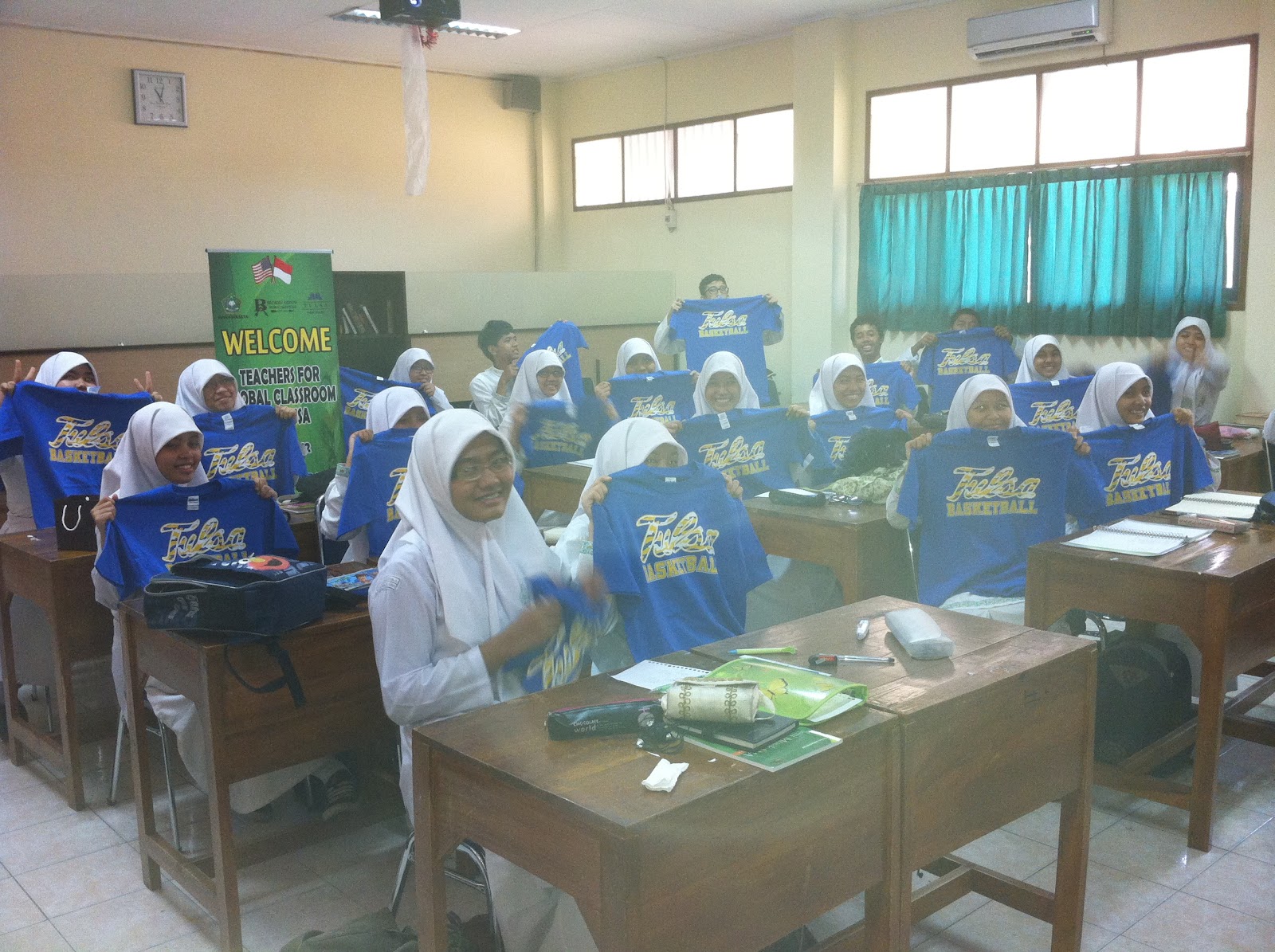
But before the ceremony, Jeanne and I had brought gifts to share with the students and teachers, so we spent the morning hours passing these out to the senior and junior classes.  Jeanne had several University of Tulsa t-shirts that proved very popular.  Students were also intrigued by the rowdy towels donated by the athletic department on behalf of the basketball team.  By the time we had done this, we were ready to return to the principal’s office for lunch. 
Class 12 displaying their new t-shirts


Novi had asked the hotel kitchen staff to prepare sandwiches for us, since we wouldn’t be leaving campus that day.  But since the two students (Lantana and Dibya) who were going to be masters of ceremony stayed and talked with us, we didn’t want to eat in front of them (they were fasting).  Our box lunches were out of sight, but the water and baked goods and pastries the school provided for us every day were on the table in front of the girls.  We felt bad about this, but they didn’t seem to mind.  We did, however, wait until they left before we had lunch. 


Dibya and Lantana
About 4 PM, Novi said we needed to prepare for the closing ceremonies, so Jeanne and Novi dressed in their kebaya.  Dibya and Lantana returned and they looked beautiful in their clothes.  The hall for the ceremony was in another building, and when we arrived, the TGC banner was already hung on the stage, the keyboard and Mr. Tommy were ready, the tables were set, and the girls did a mic check.  There were several people there, including the head master and the district superintendent for curriculum from the Ministry of Religious Affairs.

Head Mistress Dekok and the Superintendant of District Curriculum from MORA 


Dibya and Lantana announced (both in English and Bahasa Indonesia) what the program would be.  There was an opening prayer, speeches (superintendent and head master and then Jeanne and I), singing (Jeanne and I sang Oklahoma! and ‘Top of the World’), and then exchanges of gifts.  One last surprise: Dibya sang a traditional song and wanted me and Jeanne to dance.  Which we kind of did.  It was a bit of a surreal experience.  The ceremonies concluded with a beautifully sung call to prayer and the MAN 4 drumming group.  After all of this, we were ready to break-fast (even though Jeanne and I were not technically fasting, we were hungry).

This was a very joyful closing ceremony, and we will always remember the friends we made at MAN 4.  We have talked about collaborative work and teleconferencing, and Jeanne and I will work very hard to make sure that happens.  Everyone we met was very gracious and did their best to make us feel welcome and honored.  We have learned a lot not only about the Indonesian educational system but about ourselves and our home schools.  I hope we are about to embark on further adventures in collaboration and understanding.

Thursday, July 26: We've Got Good Chemistry

Because of the late night the evening before, we started a little later in the morning for school.  I had the opportunity to teach my second chemistry class, and this time it was juniors whose teacher was a young man in his late 20s.  The class immediately walked in and put on their lab coats without any prompting, so I think they were more used to actually doing lab work than the class before.  We had a good discussion about characteristics of acids/bases and pH and what that scale meant.  They seemed to answer questions more readily than the last class, and when it came time to explore on their own, they very enthusiastically took up the challenge of neutralizing the acid.  In fact, most groups asked for more materials and wanted to do the reaction over and over.  One group of girls was especially pleased when they got the purple color that indicated a neutral solution.  When we discussed the practical applications of this lab, and I said that many colors could be produced through such interactions with indicators, one boy asked if he could make a blue shirt at home.  I think I might have seen the birth of an organic chemist! 

The chemistry teacher who accompanied the class had brought a camera and was taking photos of his students doing this lab.  At first very serious, he seemed to get into the swing of things and enjoy seeing the students so eager to work on their own.  I thoroughly enjoyed working with this class and appreciated their enthusiasm.

I thought we were going to present to one more class, but Novi instead had a special tour for us: Dibya (the young girl who sang ‘It’s Now or Never’ at the Hari Anak celebration) took us to the music room and explained what all the traditional instruments were.  She even let us try to play some of them!  After this, we were returning to the office, when we saw the junior high students preparing  for prayers at the mosque that was under construction [pics here]  I was taking some photos, when the English teacher came up and asked who we were and what we were doing.  We explained and then he was very friendly and explained how they had an exchange program with a school in Australia.  We might have talked more, but we were on a schedule and needed to go meet the music teacher.


Novi had asked if we had an ‘American cultural performance’ that we could do at the closing ceremonies on Friday, and when we said no, she asked the music teacher if he had something we could sing.  Turns out he did.  Mr. Tommy not only spent time telling us about the various kinds of traditional music, he had several karaoke songs downloaded on his keyboard.  When we saw that he had The Carpenters, we agreed to sing ‘Top of the World’ and had an impromptu practice in the teachers’ workroom (with lots of interested lookers-on).  Novi seemed satisfied with the way things were going and then said we were done at the school for the day and would leave for batik shopping but first we swung by a special Sundanese (W. Java) restaurant. 

Because it was Ramadhan, they were only serving take-out, so we got boxes to go for the textile museum.  There was a surprising variety of foods but most contained meat, so Novi steered me clear of those.  Jeanne toyed with the idea of eating one of the specialities: lung!  In the end, she decided to forego the experience.  Even brave women have their limits.


Only part of the textile museum was open, but we were able to see some lovely older pieces.  We also saw the batik-making process and it is a painstakingly­-slow one (which is what makes hand-made batik so expensive).  Hot paraffin is melted and placed in something that looks a bit like a pipe, but with a small opening in the bottom of the pipe.  Wherever the wax touches, the cloth won’t be dyed.  As we walked around the gallery, the signs by the individual pieces noted whether the dyes were synthetic (kimia, chemical) or natural (alam, which was a word I had just learned from Wiharti when doing the indicator lab).

The school vehicle had left earlier with the other teachers, so Novi got us a taxi (not always an easy thing to do) and when the driver attempted to merge from the museum driveway into the ever-flowing traffic, a man I thought worked for the museum stepped out into traffic and held up his hand so we could ease in.  I later learned that he was just a random guy on the street and the taxi driver had tipped him the equivalent of 50 cents to do this.

Before we returned to the hotel, Novi had one last surprise for us: an upscale department store that had a batik boutique (say that 5 times quickly!).  There were so many beautiful items and we spent quite a lot of time searching for souvenirs.  Because I hope some of you who will be receiving souvenirs are reading this blog, I’m not going to describe them.  Just expect some pleasant surprises.  With our special purchases, we headed back to the hotel and prepared for our final day at MAN 4.

Sunday, July 29, 2012

Tuesday in the Lab

We left at our usual time (6:00 AM) for MAN 4, and once we arrived we went to the principal’s office where we were served tea (this was our morning ritual).  I was then escorted to the chemistry lab, where I spent the next hour preparing the red cabbage indicator solution.  Jeanne was taken to a math classroom, where she taught a lesson on logarithmic functions (I’m not sure in which class this occurred, but during one of her presentations, the students were a little frustrated because they didn’t have a formula.  But that was the point of the lesson; they were to develop it themselves.  Their teachers commented more than once, “I think they need the formula to solve the problem.”  I think the teachers were concerned that their students might not appear to be as bright as they really were and were pleasantly surprised that the students, in fact, did NOT need the formula).

While I was preparing the cabbage, Wiharti (she was the chemistry lab teacher) helped me assemble the other chemicals I needed.  I finished about 15 minutes before students arrived, so Wiharti took this opportunity to show me the tins of sodium they had (and they had several).  She didn’t speak English, but because she understood what I was trying to do with the lesson, she thought I might want to do a whiz-bang sodium-exploding-in-water demonstration.  She must have understood that I thought that wasn’t a good idea, but she got out some sodium any way and I recorded the reaction.

Once the students arrived (and they were sophomores), I went through the lesson about indicators and pH.  The boys were a bit talkative and sat in a small group on one of the rows of lab benches.  The girls were answering my questions about background knowledge of the subject but the boys weren’t, so I started a small competition by keeping score of which gender correctly answered the questions.  This seemed to get the boys more engaged and arouse their competitive spirit.

After the demonstration, the students got an opportunity to try a neutralization reaction (they had indicator in the acid, so it was hot pink and they tried to adjust the pH by adding sodium hydroxide until they achieved a purple color).  The first group to do this seemed quite happy.  The students had told me earlier that they had never been to the lab; since this is the beginning of their school year, I wasn’t sure if they meant just this year or ever.  But maybe it was the latter since they didn’t seem to be very sure of handling the equipment.  Students in the lab.

When the lesson was over, we (by this time, Jeanne had finished her lesson and sat in on mine) asked how much time we had left and were told 10 minutes.  It actually turned out to be 45 minutes, and this turned out to be a fortunate event as it gave us a chance to talk with the students.  Jeanne asked them what they wanted to do later in life and what made them happy.  Some students responded with, “I want to be an engineer” or “I want to be a scientist.”  One very bright girl (she spoke English well and had been answering most of the questions) said that religion was the most important thing; it took precedence over all other interests. 

Jeanne also asked the students about a song we had heard the night before at the Ministry of Religious Affairs.  The students told us it was the national anthem and sang it for us.  At first reluctant, the boys finally joined in with gusto and it was very impressive to hear the combined voices of the students.

Novi came back to escort us to the principal’s office, and after a brief collecting of our belongings and thoughts, we headed out to our next lesson.  This time, I wasn’t in the lab, so I just did our new PowerPoint presentation.  When I was finished, I still had time, so I showed the students some recordings of MY students in the lab.  They laughed, because my students were dressed so differently.  So, I asked if I could record them and they laughed even more and seemed very eager to be recorded.  Once I had recorded them, I played back the video and they were really giggling.  Some even stayed after the bell rang becausethey wanted to see themselves.  Kids are kids no matter where they’re from!

After this lesson, Novi took us out for lunch at the same mall where we had eaten Monday, but today we ate at a Chinese restaurant.  There were curtained barriers between the food court and the rest of the mall so that people who were eating wouldn’t be seen by the people who were fasting.  But Novi sat and watched us eat; I felt bad but at least she bought some food to take home for dinner.

After stopping by the grocery part of the Carrefour store, we spied a durian ice cream vendor.  Novi asked if we wanted to taste a little, so we did.  It kind of tasted like vanilla custard but as it hit the back of the tongue, the sewer gas aroma of the fruit itself made itself known.  Novi took pictures of our faces and laughed at the contortions we made when we got the full effect of the durian. 

After this, we headed back to the hotel and crashed.  Delayed effects of jet lag?  Staying up too late the night before?  It had been a long and interesting day.

Saturday, July 28, 2012

At The Ministry

Jeanne, Novi and I arrived at a very elegant office building near the center of Jakarta.  Novi told us this was the building for the Ministry of Religious Affairs and it had a very large foyer, where tables were being set up with decorations and serving dishes.  At one end of the building was a large reception area with a separate serving line and a multitude of tables.  At the other end of the foyer was a large auditorium with a stage.  The seating was temporary, with many row of chairs swaddled in white Spandex-type material.  I thought that was very practical, since the covers could easily be taken off and washed and the chair remained clean.  We had arrived around 3:00 and were taken to a corner area of the foyer while all the preparations took place.  It was obviously an area for over-flow seating, and I thought this was where we were going to sit for the performance.  I could not have been further from the truth.

At 4:00, we were ushered in to the auditorium and escorted to very comfortable leather club chairs that had been arranged in the front two rows.  We sat there through the final rehearsals and while camera and sound checks were done.  Three lovely young ladies dressed in kebaya (a traditional Indonesian dress) from MAN 4 sang “It’s Now or Never” and other young people practiced how they would pass out gifts to a group of orphans (the minister would later do this for real).

Now it was show time!  Cameras rolled and the VIPs began to stroll down the aisle to take their place in the front two rows of leather chairs.  A young girl in a red kebaya served as master of ceremonies (her father had been doing this during the rehearsal) and she had such clear, elegant diction!  She announced all the various performances, but first two young men came on stage and sang an opening prayer.  Next, a group of young women sang the national anthem.  With the exception of two speeches (one by the minister), all of the performances and announcing were done by youth, because after all, this was the National Day of the Child Drumming performance by MAN 4.

The performance part of the evening ended with the minister presenting gifts of clothes and books to the orphan children and then a group of drummers from MAN 4 performing and one young man with a beautiful voice singing the closing prayer.  We thought we were leaving after this, but Novi escorted us to the reception area where we broke-fast with everyone.  The first food eaten kind of reminded me of candied sweet potatoes: it was a cup of a syrup that looked as if it were made with brown sugar and had small, round orange dumplings and pieces of a translucent fruit.  The table was laden with rice, meat, fruit, salad (gado-gado) and desserts.  The table where we sat already had two dishes of different desserts and a plate of dates.  It was a very festive occasion.

After dinner, Novi excused herself to go pray in a small room.  Afterwards, we headed to the street to find a taxi and found ourselves crossing a road where traffic never stops; you just put your hand out with the palm facing drivers and step out on faith.  Cars do stop and you just kind of weave your way through several lanes.  Once we safely were in the taxi, we relaxed for our trip back to the hotel.

Friday, July 27, 2012

First In-Class Presentation

Our first classroom visit was to one of the ‘international’ classes.  These classes are supposed to be taught in English, and there was a visiting professor from a nearby university who came to lecture.  For the convenience of the lecturer, they lectured in their subject for two block periods for one day.  For example, Monday was dedicated to biology, so students had biology for four hours that morning.  Tuesday was for math (calculus), Wednesday was physics and Thursday was a chemistry lecture.  We were told all math and science classes were taught in English, but the biology lecturer was speaking Bahasa Indonese and only the vocabulary she wrote on the whiteboard was in English.  After about 20 minutes, she walked over to where Jeanne and I sat and talked to us about the difficulties of maintaining students’ attention during such a long block.  She also spoke about students’ misconceptions in distinguishing monocots from dicots.  She said they seemed to think that any slender plant was a monocot, and she told them that the papaya is a very slender plant but nonetheless a dicot.  We discussed how this misconception can best be addressed.  She talked to us for several minutes and I think both she and the students were grateful for the break.  At the end of the period, she took attendance and then left.  It’s the students who remain in the classroom, not the teacher. 


Novi then came and whisked me and Jeanne away to separate classrooms, where we showed our presentation about Oklahoma.  In the classroom where I was, like the first class, it was predominantly female (70%) and Jeanne later said the same thing.  There is no computer in the room because each teacher has his/her own laptop and there’s just a video cable available so the teacher can plug the laptop into the projector.  The teacher who had just been in the class left her laptop and I just plugged in my flash drive.  The students in the class were the ones in charge of technology; they connected the computer, stood on a desk to turn on the projector, and brought a power supply when the laptop gave a low-battery warning.


The students were polite during the presentation, but when I got to the slide about the type of food we eat, they started oohing and aahing and I felt guilty for flashing images of food in front of them while fasting.  Little things that you don’t think of when you’re creating such a presentation!  I had barely finished and asked for questions when Novi returned and escorted me back to the principal’s office.


While there, she had a discussion with us about the impossibility of eating on campus since the cafeteria did not provide any food during Ramadhan.  She asked if it would be all right to go off campus, so we went to a nearby mall.  While we were discussing this, the principal’s phone rang and I was quite startled to hear that her ring tone was ‘Dixie’!  How's THAT for globalization?


Most restaurants in the mall’s food court were open but had temporary curtained barriers up so that people who were eating would not be seen by people who were fasting.  Probably a good idea!  After lunch, we stopped by a Carrefour store (kind of like a super Walmart) and picked up some red cabbage (for my chemistry lesson the next day) and some disposable cups (for Jeanne’s lesson with pennies about logarithmic decay).  After this, we thought we were heading back to school or the hotel but instead we drove almost to the center of Jakarta for a very special event: Hari Anak Nasional Tahun 2012 (the national day of the child).  I’ll write more of this later.