Tuesday, February 12, 2013

Greater Love Hath No Man (or Woman)

I teach chemistry (among other subjects, but this is a chemistry story, because after all, when you're attracted to someone, it's because the chemistry is good, eh?) and today we were working a stoichiometry problem involving a reaction that produced a gas.  Sounds intriguing, no?

This is the problem: 
In 1897 the Swedish explorer AndreĆ© tried to reach the North Pole in a balloon.  The balloon was filled with hydrogen gas.  The hydrogen gas was prepared from iron splints and diluted sulfuric acid.  The reaction is  

                Fe(s)  +  H2SO4 --> FeSO4(aq)  + H2(g) 

The volume of the balloon was 4800 m3 and the loss of hydrogen gas during filling was estimated at 20%.  What mass of iron splints and 98% (by mass) H2SO4 were needed to ensure the complete filling of the balloon?  Assume a temperature of 0 °C, a pressure of 1 atm during filling, and 100% yield.
We solved the problem, but the polar exploration triggered the memory of one of my favorite stories in the book, Scientific Anecdotes.  Because this was my first hour pre-AP chemistry class, and I would not have a 5th hour today due to a pep assembly, I felt I could be a bit more relaxed in our curricular pursuits.  So I asked the students if they would like to hear a story about a brave group of explorers of the South Pole.  Of course they would (if it meant we would just lay off the stoichiometry for a few precious moments).  So I proceded to read the tale of Robert Scott and his tragic expedition that had attempted to beat Roald Amundsen to the pole.

Amundsen practically taunted Scott to a race to the pole after he (Amundsen) had more than adequately prepared his expedition.  Scott, who was in New Zealand when he received the challenge, hurriedly got his group and supplies together.  Unfortunately, Amundsen not only beat Scott's group to the South Pole, he left a letter for Scott to deliver to the Norwegian king.  Insult to injury, and all that.

Faced with evidence of their defeat, Scott and his group began the long trudge back to base at McMurdo Sound.  Long, as in 350 miles.  The men were on short rations and struggled to make it from cache to cache of food stored on the journey south.  One of the men fell and his injury slowed their progress even more.  This slower pace meant they were still far from the home base when the Antarctic winter set in with a fury.  All during this journey, Scott was writing in a journal and also penning letters to his wife, so when the first blizzard of winter set in, Scott wrote of the valor of the injured man (Titus Oates) who struggled to his feet in their little tent and said, "I am just going outside now.  I may be some time."  He never returned; he had sacrificed himself that the others might have a chance at survival.

But the sacrifice was in vain; the men were starving and did not have the energy to complete the journey.  Their bodies were recovered eight months later.  Some of Scott's last written words were: "Had we lived, I should have had a tale to tell of the hardihood, endurance, and courage of my companions which would have stirred the heart of every Englishman!" I managed to read all of that tale with no emotion.  But I had forgotten about the last few lines. 

When the expedition was found, they had been carrying along with them over 35 pounds of rocks and fossil specimens that helped geologists and naturalists understand the age and history of that remote, unforgiving place.  They were starving, dying, and yet they did not leave behind the precious cargo that would increase the store of scientific knowledge in the world.  I choked up and my eyes moistened (and it was obvious what was happening).  How can you not get a little misty-eyed in the face of such sacrifice, even if it were 100 years ago?

I have two students in that class who are from Vietnam and Taiwan.  They also cried a little, but then they stayed after class to confess they had only understood a bit of the story and wondered why I was crying.  I explained to them that the story was really about the unselfish acts of people who sacrificed themselves for the greater good.  When they truly understood what I was talking about, the tears were real.  Love, sacrifice and empathy are part of the universal language just as much as music or mathematics.


Even in this photo with all members of the party alive, you can see the toll the extreme conditions were taking.


Monday, February 11, 2013

A Secret Admirer

Memory is a tricky thing.  Sometimes we remember events in great detail but every detail can be wrong.  For example, I have a very distinct memory of how I learned of President Kennedy's assassination: I was five years old and visiting the house of my best friend's maternal grandmother.  Mrs. Laughlin, standing in her warm, cozy kitchen and smelling of freshly baked bread, bent down towards my friend Beth and me and exclaimed, "Oh, children!  The president has been shot!  He is dead!"  The only problem with this story is that when I was discussing it years later with my mother, she said, "You couldn't have heard that from Mrs. Laughlin.  We were still living in the parsonage and hadn't even moved out to the Garzelli's property.  You didn't even know Beth."

That stunned me.  I accepted the logic of my mother's memory and the timeline of our stay in Waynesville, but that acceptance in no way affected the memory.  That's still the memory I have of JFK's death, although it must have been my friend Beth's memory, not mine.  But I have definitely appropriated it.  So with the perfidy of memory in mind, another beautiful little memory sprang to my mind Saturday afternoon as I was preparing a little Valentine's treat for my friends.  I'm fairly certain this is true.

I always use green ink to correct student's work.  I have always hated red marks; they look so angry and accusatory.  So I adopted green, which represents gentle correction and encouragement of growth.  But even before I articulated the reasons why I was drawn to green ink, I liked it.  Just liked it and didn't really know why.  But as I was writing some cards Saturday, I suddenly remembered a story I had read in elementary school.  

A short story, it told of a young red-headed girl who was very attractive but didn't believe it.  She thought her red hair made her look different and she was embarrassed by it.  But to her father, she was a princess and he always told her how lovely she looked.  Of course, she didn't believe him because he was her father and he had to say things like that.  When Valentine's Day came around and there was the obligatory exchange of valentine cards in the classroom, the girl discovered a valentine written in green ink from 'a secret admirer.'  That one little card was enough to make her reassess her looks, and she began to glow with confidence.  She had a secret admirer!  She was beautiful!  Just like her father said.  I believe the story ended with the father and mother exchanging knowing looks as the girl happily took off for a party she would never have gone to before the secret card incident.  And after she left, the father re-capped his green pen and tucked it well away in his desk drawer.


The chemistry of attraction is definitely a mystery, and one to be celebrated in a variety of ways this week; but at least the little mystery of my secret admiration of green ink has been solved.  And that's satisfying enough.

Friday, February 8, 2013

Death Comes to Us All

And to some by court edict.  We've just begun a project in my forensic classes that involves researching cases of people who have been exonerated of various crimes through DNA evidence. As a prelude to the project this year, I asked students to write a brief paragraph explaining their opinion of the death penalty.  Some groaned about writing anything; others claimed they didn't have an opinion and wanted to know if they still had to write something.  And some just dived right in and let their thoughts coalesce into loops of ink and graphite.

As I was wandering around the room, one student looked up and asked, "Is it OK if I say they should spend about a year in jail and then be executed?  Is that too wishy-washy?"  I assured him it wasn't and asked why he thought that.  I already thought I knew the answer; from the title of the project, I guessed he wanted the year as a guard against injustice being done.  New evidence might emerge, after all.  But he replied, "I think they should be punished by spending a year in jail in case the atheists are right."  Who would think you could laugh about the death penalty?

As I read the essays, it became obvious that most students had really wrestled with the question and weren't just spouting received wisdom.  There were very few who were absolutists on the subject, and most were quite vehement about the level of evidence required and the nature of the crimes committed to impose the ultimate penalty.  Many mentioned the recent Newtown shootings and child sexual abuse as the kind of crimes that warranted such a sentence.  Others wanted absolutely incontrovertible evidence: DNA; video footage; at least five eyewitnesses.  In fact, for some students, the level of proof was so high, I doubt the death penalty would ever be imposed if they were jurors or judges.

Of the students who were in favor, many cited reasons such as expenses in maintaining prisoners in 'fancy facilities'.  They seemed to think that prison was similar to an extended stay in a Hyatt Regency hotel.  I think I may have to provide some passages from Grisham's 'The Innocent Man' or Damien Echols' 'Life After Death' to provide a realistic view of life in prison.  It may sound like I'm trying to sway opinions with that last comment, but I just want students to have all evidence in front of them before they make a judgement.  And sometimes that evidence is eye-opening, as in the case of the true expenses involved in trial/conviction and incarceration of those sentenced to die.

Considering that so many students (even those who really had no qualms about the imposition of the death penalty) were very specific about crimes that deserved the ultimate sentence, I wonder what they would think of this? 


Many countries in the world have abolished the death penalty, but you can see from this database which countries have executed people in the last year data was available (2010).  China led the way with 6,000 executions, but the United States was number 4 on the list.

What do I think?  Stay tuned after students complete the project.  Teachers can be cagey like that.


Sunday, December 2, 2012

R.E.M., anyone?


In spite of all the jokes I've made or heard or cartoons I've seen regarding the end of the world, I had no idea what serious business it was to some people.  I should have guessed, though, after such events as the members of Heaven's Gate cult committing suicide back in 1997 in order to meet the 'mother ship' that was trailing comet Hale-Bopp.  But then I heard a news story about how so many people were contacting the astrobiologists at the NASA site about December 2012 and the end of the Mayan calendar that NASA felt compelled to post videos and facts debunking that myth.  The really sad part is that the 'Ask an Astrobiologist' writer has received emails of people contemplating suicide and stories of children who have nightmares and can't sleep because they're so worried.  Adults have the ability to reason through this; small children don't.  In fact, sometimes the teens I teach don't seem to have that ability, either.

I, as most teachers I know, are usually as busy on the weekends (grading, lesson planning) as during the week.  And if they're procrastinators, as I sometimes am, then Sunday evenings can be a very stressful time of playing catch-up.  The particular weekend I'm thinking about occurred three years ago.  I had everything done by mid-afternoon Sunday (tests graded, lessons planned, supplies bought for an upcoming lab AND all my housework done!), so I called some friends and we went out for a movie and dinner.  It was so unusual for me to go out on a Sunday evening (and put me in such a buoyantly good mood for Monday), that I joked around with one of my classes that I now knew for sure the world was coming to an end.  I didn't explicitly state that it was because of my actions on Sunday evening, but I had just been talking about the movie I had seen (before we got down to the hard work of stoichiometry), so I assumed my students would take it as a joke in the fashion of, "Little Susie Q ate her Brussel sprouts; the world must surely be coming to an end!"  You know, that kind of hyperbole that makes you smile.

After class, two of my students came to me with worried and serious looks.  "Mrs. A, how are you so sure the world is coming to an end?  Is it because of the Mayan calendar thing?" I must have made a kind of strangled sound from choking back laughter (I didn't want to offend them), and explained I knew no such thing with certitude; I had just done something unusual for me on a Sunday evening, so I joked about the world ending because of it.  The girls looked relieved, and one told the other, "See?  I told you she was joking!"  Umm, sure.

Piaget was correct in his observations about concrete vs. abstract thinkers and the range of ages it takes to reach the abstract stage.  And sometimes we forget that to the potential detriment of our young listeners.  So, here's to the end of nightmares and not the world!


Monday, October 22, 2012

We Didn't Start the Fire

Such a lovely garden entrance before!
Just a few weeks ago, some of my parents' good friends woke up in the middle of the night to the sound you only want to hear when you're making blackened tilapia: the smoke detector shrieking its warning. Very sorry to report it was not a false alarm but something had gone amiss in the attic and the pictures you see to the side and below are the aftermath of that blaze.  Mom and Dad had gone over in the middle of the night to help out, and I went by later on an errand.

The firefighters had returned because another 'hot spot' had been discovered, so the fire engine was at the curb.  The entire middle section of the roof was gone, and the fire chief wasn't very enthusiastic about allowing anyone inside (it was quite unstable), but he did allow their son to go inside and cart out important things like photos.  Several of us who helped carry salvageable items to kind neighbors across the street were allowed to go to the front door.  I had never been this close to a house fire so quickly after it had been extinguished, and as I walked up to the door I was all too aware of beams that appeared to be hanging by the thinnest of slivers of wood.  I guess I'm one of those people who have to experience something to really understand all of the ramifications.  I respect and admire firefighters, but in that moment I felt just a little fear for myself, and the point was driven home about what these men really face on every call: the possibility of death.  I don't think I'm a stupid person, but I think I just took them for granted, never fully appreciating the risks they take.

Close-up of the entrance

From a distance, the extent of the roof damage is even more stunning
Trying to salvage precious memories.


 That was a few weeks ago.  Just this past weekend, my parents and I traveled to Austin to see my son.  I also have a cousin who lives in Austin, and her husband happens to be a firefighter.  Jerry invited us to see the fire station where he worked, and we all very eagerly took him up on his offer.  We arrived around 3 PM only to find that the four-man crew had been called to an emergency.  Some calls last longer than others, and that one was relatively short.  When Jerry and his crew mates arrived, they tucked in to some of the delicious churros my cousin had brought for them.  In the meantime, Jerry showed us around the engine and explained its operation and some of the intriguing equipment stored in it.

Rajiv was allowed to use one of the smaller hoses
The tank holds upwards of 500 gallons of water, and with the larger diameter hose, can be emptied in about 5 minutes.  With the proper hose on the intake valve (and sufficient water pressure), it can also be filled in almost the same amount of time.  The pressures and flow rates for this to happen just boggle my mind.  In fact, all I could think of as Jerry was talking was how many exciting physics and chemistry lessons (real-life problems) could come from a fire engine (and an enthusiastic host!).

If you glance through the pictures below, you might get an inkling of the danger involved in this work and the mental and physical stamina required to be good at it.  Quite often, societal success nowadays is judged by how large a bank account one has.  I've no idea how much Jerry and his fellow firefighters make, but I'm quite sure it's too little for what they're really worth.  And I'm also quite sure that if they are willing to risk their lives to save another human's life, we will never be able to pay them what they're worth.  So the least we can do is admire, appreciate and THANK them for what they do.  And this is my very small way of doing that.
At the valve controls

Close up of the controls and gauges

Jerry demonstrating the size of the wrench needed to open a fire hydrant

All folded neatly away, one would never guess at the weight of this when filled with water.

Water cannon

More hoses

Absolutely vicious looking tool, but it can free people from wrecks as surely as the 'jaws of life'

Even pets can be rescued!

The truck and equipment looked clean, but Jerry's hands told another  story after the demonstration.

Mom and Rajiv in the truck.  Mom put on Jerry's hat backwards so you could see his name.

My favorite: the TIC (thermal imaging camera).  This can 'see' heat from a fire behind a wall or detect a human even through thick smoke.

Jerry suiting up: fully outfitted, his equipment weighs about 65 pounds.  And that doesn't even include the weight of the hose he must carry.

Everything except the gloves.  With everything on, his 'clothes' are worth about $3,000.  But Jerry?  He's priceless!!


Monday, July 30, 2012

Debriefing Day and The Curious Incident of the Dog in the Night

On our final, full day in Jakarta, we all came back together for a debriefing session in one of the hotel’s meeting rooms.  Even though most of us had been blogging throughout the trip (some did not have internet access consistently), sometimes it’s difficult to process ideas, thoughts and emotions immediately after the experience.  So this meeting was an attempt to synthesize what we had observed, learned and gained from our journey. 


We had a broad range of school experiences: some of us were in public schools, some private, some religious but none really secular (at least via comparison with US schools).  One teacher duo (Nancy and Arlis) lived in the shadow of a volcano, walked past rice paddies to school and had classes in the forest.  Another team (Amy and Jennifer) were in a school that seemed to have every convenience and teaching methods that were more akin to what we experience at home.  Yet another team (David and Daniel) were in a private, military boarding school with tuition of $400/month and a host teacher who was a Christian.  If you haven’t checked out other blogs (the link at the top of this page will take you to my Weebly and under ‘Resources for Teachers,’ there are links to all the blogs), I would encourage you to do so because we had such a variety of experiences. 


Mosque at Miniature Indonesia
But I would say the commonality of all our experiences is the utter graciousness of our host teachers and schools.  They did everything possible to insure we would have a good experience in Indonesia.  Another commonality experienced was frustration with the nature of the traffic; it took a long time to cover even fairly short distances and I feel this cut down on our exploration time of the city.  We came across a beautiful book in the batik boutique about all the mosques in Jakarta, but we didn’t have the opportunity to explore any of them.  Driving around the city, we could certainly see a multitude of different designs for mosques but rarely up close. 


Tellang flower and seed pods
One of the reflections Susanna asked us to write was about memorable experiences here, the small moments that are more cherished than mere sight-seeing.  Two of the most moving for me were the young girl in a wheelchair at the Hari Anak Nasional celebration and Wiharti’s (chemistry lab teacher) eagerness to share botanical treasures.  The young woman gave a very moving performance of a poem urging more help and compassion for the disabled, and even though it was not in English, her emotions came through the barrier of language.  Wiharti was a small woman, who, once she understood what I was doing in the lab, brought in some flowers (tellang) and seemed so delighted that she could share those with me.  I still see her bright eyes.


The lantern in the tree
We finished with the debriefing around 3:00, so there was plenty of time before dinner.  Although nothing was formally arranged, all but two of us ended up at a wonderful restaurant called Lara Djonggrang.  The ambience was just magical; the restaurant was set back from the street in a courtyard that had a huge banyan tree and amidst the hanging rope-like roots were hung glowing lanterns.  A statue of Ganesh stood by the door and we walked into high-ceiling rooms with a multitude of smaller, intimate dining rooms.  There was a large red bust of Buddha that separated our dining room from another.  Large stone carvings were everywhere and even the menus were spectacular.  Oversized and in red, they promised (and delivered) a mouth watering array of dishes.  But the best thing about the menu was the legend of Lara Djonggrang.  She was a princess of stunning beauty whose hand in marriage was sought by an evil warlord, Bandung Bondowoso, who had slain her father.  She cagily agreed to marry him but only if he could construct 1,000 temples in one night.  He, of course being the evil person he was, commanded an army of demons to perform this task.  As the night drew to an end, Lara was afraid he was actually going to be able to complete the temples, so she had her handmaids pound rice and spread fragrant flowers around the palace, which attracted roosters which began to crow.  Smelling the flowers and hearing the roosters, the demons feared that the dawn was approaching (and the demons could only be about at night), so they fled, leaving only 999 temples.  Bandung was not a gracious loser and he turned Lara into a stone statue, to stand loveless in the temple forever.  But the maidens of the kingdom prayed for her release, and she was taken into heaven, riding on a Javanese mythological lion.  So, this dutiful and loving daughter at last had peace.

David, and the literary menu

Even the rice was artistically served in the shape of a traditional puppet head
What a perfect ending to our time in Jakarta!  And, if you’re wondering about the incident with the dog, unlike the Sherlock Holmes story, the curious incident was that we heard a dog bark.  Curious because we had never seen a single dog while in Jakarta, and just before we reached the restaurant, we heard one bark.  I think it was a good omen.

Last Day at MAN 4

Novi had told us there would be a closing ceremony on Friday, and we thought it would be right after lunch.  She had actually said after Maghrib, but we assumed that was right after lunch.  It turns out, that is the time for prayer as the day is changing from evening to night, and I discovered this by asking her what the different prayer times were called.  She wrote them down in my journal: Shubuh (dawn); Dzuhur (noon); Ashr (afternoon); Maghrib (twilight) and Isya (evening).  That’s when I realized the closing ceremony would not be until around 5:00.  As it turned out, that’s because the school had planned a big dinner to break-fast after the ceremony.


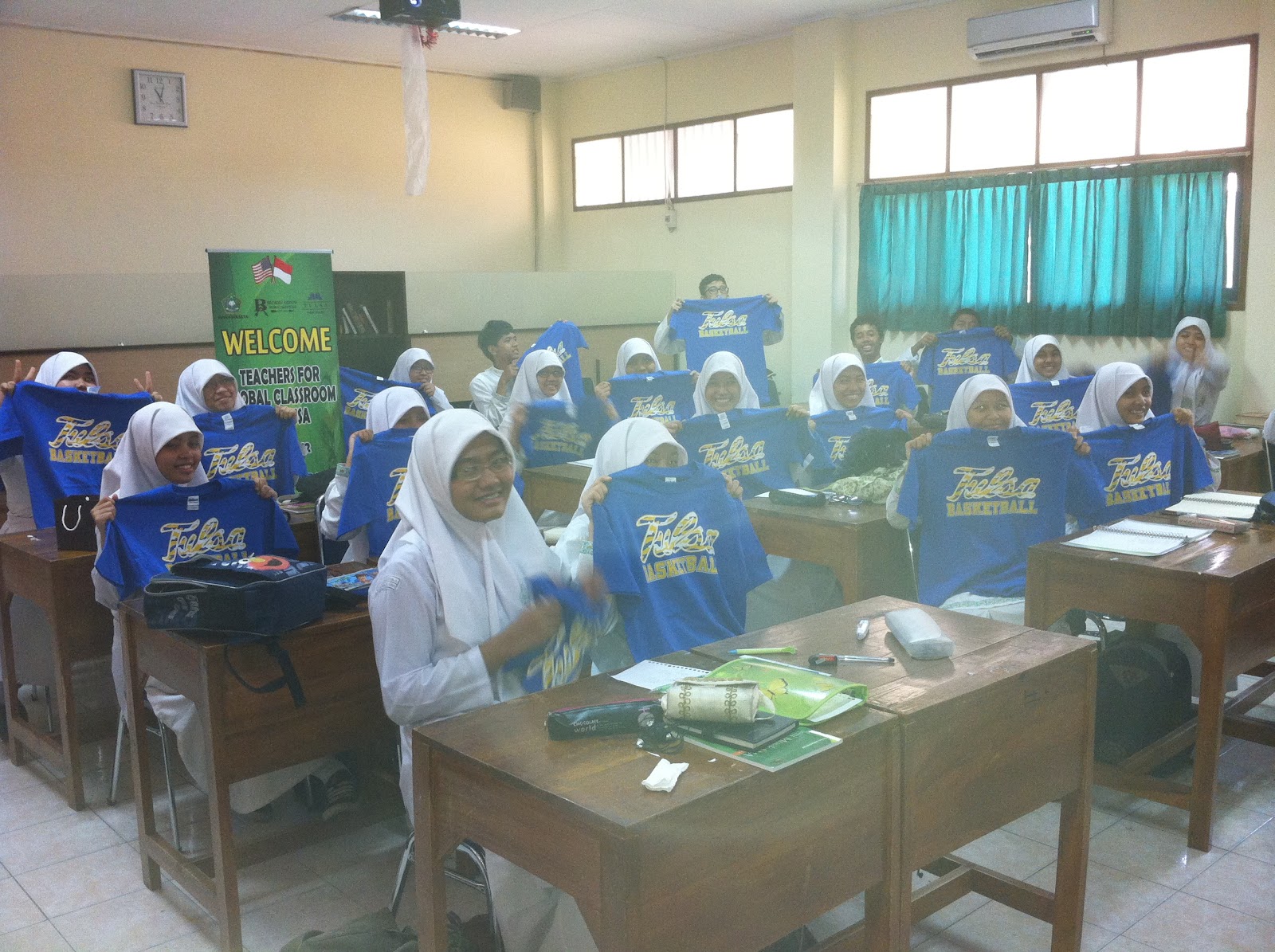
But before the ceremony, Jeanne and I had brought gifts to share with the students and teachers, so we spent the morning hours passing these out to the senior and junior classes.  Jeanne had several University of Tulsa t-shirts that proved very popular.  Students were also intrigued by the rowdy towels donated by the athletic department on behalf of the basketball team.  By the time we had done this, we were ready to return to the principal’s office for lunch. 
Class 12 displaying their new t-shirts


Novi had asked the hotel kitchen staff to prepare sandwiches for us, since we wouldn’t be leaving campus that day.  But since the two students (Lantana and Dibya) who were going to be masters of ceremony stayed and talked with us, we didn’t want to eat in front of them (they were fasting).  Our box lunches were out of sight, but the water and baked goods and pastries the school provided for us every day were on the table in front of the girls.  We felt bad about this, but they didn’t seem to mind.  We did, however, wait until they left before we had lunch. 


Dibya and Lantana
About 4 PM, Novi said we needed to prepare for the closing ceremonies, so Jeanne and Novi dressed in their kebaya.  Dibya and Lantana returned and they looked beautiful in their clothes.  The hall for the ceremony was in another building, and when we arrived, the TGC banner was already hung on the stage, the keyboard and Mr. Tommy were ready, the tables were set, and the girls did a mic check.  There were several people there, including the head master and the district superintendent for curriculum from the Ministry of Religious Affairs.

Head Mistress Dekok and the Superintendant of District Curriculum from MORA 


Dibya and Lantana announced (both in English and Bahasa Indonesia) what the program would be.  There was an opening prayer, speeches (superintendent and head master and then Jeanne and I), singing (Jeanne and I sang Oklahoma! and ‘Top of the World’), and then exchanges of gifts.  One last surprise: Dibya sang a traditional song and wanted me and Jeanne to dance.  Which we kind of did.  It was a bit of a surreal experience.  The ceremonies concluded with a beautifully sung call to prayer and the MAN 4 drumming group.  After all of this, we were ready to break-fast (even though Jeanne and I were not technically fasting, we were hungry).

This was a very joyful closing ceremony, and we will always remember the friends we made at MAN 4.  We have talked about collaborative work and teleconferencing, and Jeanne and I will work very hard to make sure that happens.  Everyone we met was very gracious and did their best to make us feel welcome and honored.  We have learned a lot not only about the Indonesian educational system but about ourselves and our home schools.  I hope we are about to embark on further adventures in collaboration and understanding.